The Revenue Gap System
We Don't Build Flows. We Close the Gaps Between Them.
most agencies ask what flows you need. We ask a different question first: Where exactly is this customer falling out of the journey—and why? Every stage of the customer relationship has its own gap.
Awareness has one. Intent has one. Objection has one. Retention has one. A flow that exists but doesn't answer the right question at the right stage isn't a working flow — it's an email that happens to be automated. That distinction is the whole system.
We don't start by writing. We start by mapping where your customers actually are, what's actually stopping them, and what specifically needs to happen next before a single word gets written.
The copy comes last, not first — because copy can only close a gap once someone's actually found it. This is the framework behind every sequence we build: find the gap, map the stage, close it with the right force and the right message.
Not a template applied to your brand. A diagnosis, built into a system that runs on autopilot once it's live.
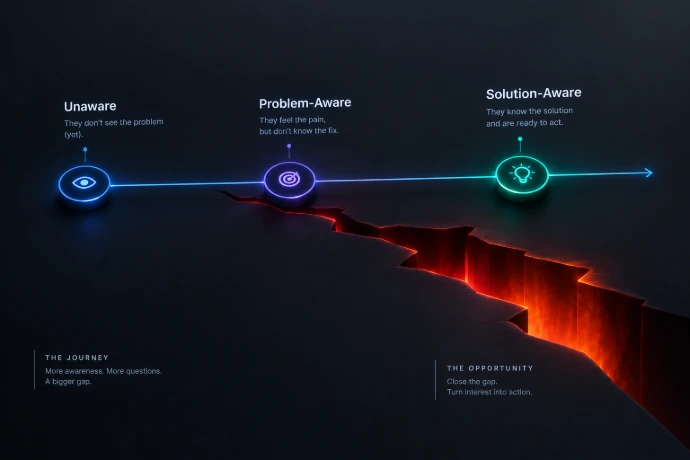
The Gap Compounds Before You Notice It
A new subscriber never remains static in the Unaware stage.Within days, their psychology shifts into Problem-Awareness, then accelerates into Solution-Awareness. They are moving through the buying journey whether your brand is operationally ready for them or not.Most brands deploy sequences for only one or two of these critical moments. The rest of the customer journey runs on two fatal mistakes:
- Total retention silence that forces the relationship to decay.
- Generic broadcasts that trigger irrelevance by ignoring the customer's mindset.
That isn't just a missing sequence. That is an unmapped stage. And every unmapped stage accumulates severe retention debt—quietly draining revenue out of your enterprise long before you notice it's gone.
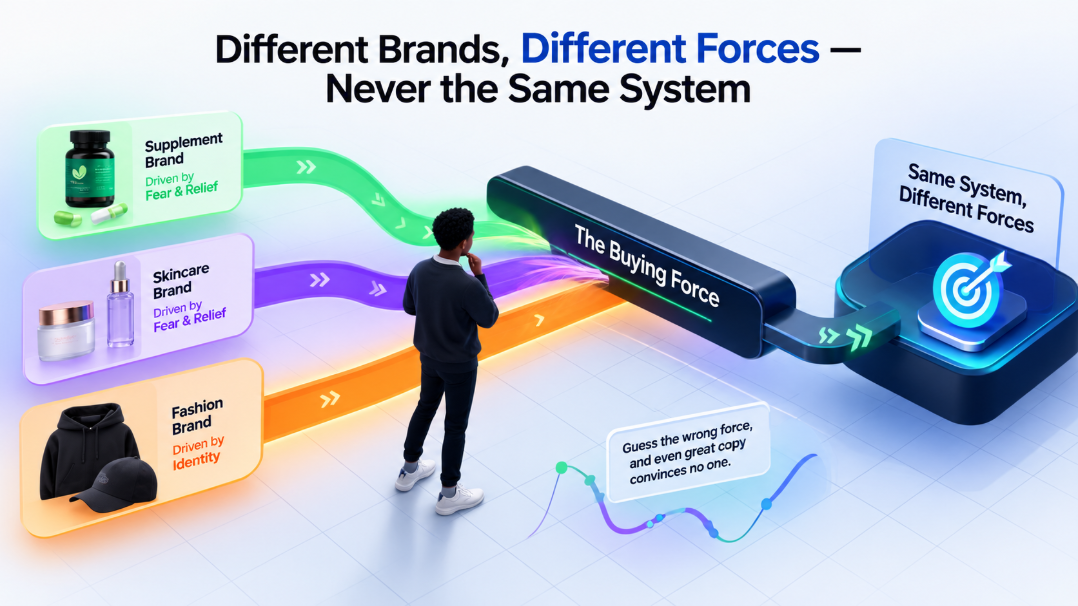
Different Brands, Different Forces — Never the Same System
Two brands can sell completely opposite physical products and still share the exact same retention architecture.Why? Because they leverage the identical psychological buying force.
A wellness supplement brand and a medical-grade skincare line don't sell products—they trade in Fear and Relief.
A luxury fashion house sells Identity and Tribal Status.
The architecture of your automated system cannot be cloned from a competitor's product category.
It must be reverse-engineered from the invisible psychological force that triggers your specific customer's wallet.
If you guess the wrong force, your text triggers immediate cognitive dissonance. You end up answering a question the consumer never asked—meaning they skip the email, and you lose the customer lifetime value.
The Work That Never Gets Mapped, Stays Unmapped
Most lifecycle setups don't fail due to structural neglect. They fail due to a severe cognitive bias: The Illusion of Urgent Safety.
There is always an active operational fire screaming for your immediate attention—a new product drop, a flash sale campaign, or a customer service crisis.
The foundational architecture that needs psychological optimization gets pushed to tomorrow.This creates a permanent operational blind spot.
Your behavioral gaps will never send you an alert. They won't crash your Shopify store or break your checkout page. They just quietly bleed money, day after day, until you actively deploy a systematic audit to hunt them down.
THE REVENUE GAP SYSTEM
A Diagnostic Framework for DTC Email Sequences That Close the Gap Between Awareness and Purchase.
Lifecycle email isn't about filling an automation with words. It's about knowing exactly which Buying Force is driving the decision, and which Awareness Level the customer hasn't moved past yet.
We map every sequence against that precise diagnosis—combining the Five Buying Forces, the Five Awareness Levels, and brand-specific proof to move a customer from where they actually are to where the purchase happens.
[ Awareness Level ] ➔ [ Buying Force ] ➔ [ Message ] ➔ [ Next Action ]
- Every email has a job.
- Every stage has a force.
- Every sequence is mapped to the exact gap it is built to close.
One Framework. Every Stage of the Relationship.
New Subscriber → First Purchase Unaware/Problem-Aware → Solution-Aware → Product-Aware → Most-Aware Turn initial interest into a confident first purchase — the Welcome & Acquisition System.
High Intent → Completed Checkout Product-Aware, stalled by friction → objection resolved → purchase Recover the customers who got closest and left — the Checkout Recovery System.
First Purchase → Repeat Purchase Purchase → product value realized → continued engagement → next purchase Extend the relationship past order one — the Lifecycle & Retention System.
Existing List → Ongoing Revenue Engaged but not currently in-market → re-engaged at the right moment Keep the list active without burning it on promos — the Campaign Strategy System.
Not every brand fits a predefined path. When the buying cycle is unusual, the sequence gets built around your specific product and objection set — starting with the Revenue Gap Audit.
Stage 1 — Problem-Aware → Solution-Aware (Force: Belonging)
Goal: Earn the right to be trusted before a single ask is made. Relevance isn't claimed — it's proven in the first exchange, or the subscriber disengages silently.
01. The Reciprocity Trigger
- Behavioral Goal: Repay the subscriber's exchange (their email, their attention) immediately — before the gap between opt-in and payoff gives them time to disengage.
- Conversion Output: Unaware → Problem-Aware. The subscriber holds a specific reason this brand is relevant, and waits for the next message instead of forgetting it arrived.
02. The Intent Signal
- Behavioral Goal: Interrupt passive scrolling with something specific enough to force a choice — not "browse our site," but "which of these is actually you."
- Conversion Output: Problem-Aware → Solution-Aware. Curiosity becomes a specific product in mind, not an open-ended catalog.
Stage 2 — Solution-Aware → Product-Aware (Force: Desire)
Goal: Collapse every alternative in the customer's mind until this product is the only one that still makes sense. Not persuasion — elimination.
03. The Value Reframe
- Behavioral Goal: Break the price-comparison reflex before it decides the outcome. Anchor the evaluation on fit and identity instead.
- Conversion Output: Early Product-Aware. The product reads as the right one, not the cheap one or the expensive one.
04. The Friction Cut
- Behavioral Goal: Too many options reliably produces no decision, not a careful one. Remove the choice, not just simplify it.
- Conversion Output:Product-Aware, without the overwhelm that usually comes with it.
05. The Doubt Removal
Behavioral Goal: Late-stage hesitation is rarely about the product — it's about being the only one who's tried it. Real proof, placed right before the ask.
Conversion Output: Late Product-Aware, bordering Most-Aware. Belief established, not just awareness.
Stage 3 — Product-Aware → Most-Aware (Force: Fear + Relief)
Goal: Convert standing intent into action before it decays. Every hour of hesitation is a hour closer to losing the sale to indecision, not a competitor.
06. The Force Alignment
Behavioral Goal: Present the offer as the conclusion the customer already reached, not a pitch arriving from outside it.
Conversion Output: The offer reads as agreement, not persuasion. No defensive reaction, because nothing's being pushed.
07. The Barrier Break
Behavioral Goal: Name the one specific thing actually blocking this purchase — price, shipping, fit, risk ,and answer it directly.
Conversion Output: Most-Aware, with no standing objection left to hide behind.
08. The Decision Trigger
Behavioral Goal: Give a real, time-bound reason to act today — not manufactured scarcity, an honest one.
Conversion Output: Completed purchase, or a subscriber who's consciously deferred — not one who simply forgot.
The Fast-Track Routing
Not every subscriber needs all eight. Some arrive already Most-Aware — they don't need convincing, they need friction removed.
High-Intent Signal → Immediate Offer → Product Match → Checkout
High-intent subscribers skip straight to the end. Everyone else moves through the full eight. One system, routed by actual intent — not a generic delay timer.
WHAT YOU GET
WHAT YOU GET A Complete Welcome Flow. Live in Your Account.
You bring the brand and give us access. We bring the diagnosis, the design, the copy, and the live build, plus a strategy PDF so your team knows how to run it.
The Output of the Diagnosis
8-Email Sequence
one complete sequence, one email per stage of the Revenue Gap Framework, taking a new subscriber from signup to first purchase.
Designed and Written Emails
Eight emails built from your customers' own words, each with one job: moving a new subscriber closer to their first purchase. Subject lines and preview text included.
Sequence Strategy PDF
the customer journey, the reasoning behind every email, what to A/B test first, and how to manage the flow after launch.
Brand & Product Adaptation
messaging shaped around your products, your positioning, and how your customers actually buy.
Built and Launched in Your Platform
we build the sequence inside your Klaviyo, or whichever platform you use, test it, and launch it. After launch the account stays yours.
Built Into How Oumardin Studio Works
You bring the brand and the access. We bring the research, the design, the copy, and the live build.Your brand. Your customers. Your account.
Our diagnosis, our design, our copy.
The Oumardin Studio Scope
We don't take over your email marketing.
We handle the specialized layer — the diagnosis, the sequence logic, and the copy — while you stay in control of your account.
Oumardin Studio Handles:
- Research & Audit — We find the exact gap in your current welcome flow before anything is built.
- Strategy & Mapping — We define the customer journey and assign every email its force and stage.
- Design & Copy — We design and write all eight emails around your brand, your products, and your customer's actual buying journey.
- Build & Launch — We set up the 8-email flow in your Klaviyo, test it, and launch it.
- Sequence Strategy PDF — We hand you the playbook for running and A/B testing it.
Your Agency Handles:
- Access — Invite us to your platform as a user with limited permissions. No passwords needed.
- Product Details — The links, images, and offer details we ask for.
- After Launch — Campaigns, sends, reporting, A/B tests, and day-to-day account management.
- Overall Strategy — Where this fits in your broader marketing plan.
We don't take over regular campaign production, account management, reporting, or ongoing email operations. After launch, the account is yours.
How It Works
From Diagnosis to Deployment
A straightforward process — the same five steps behind every engagement, start to finish.
01. Brief
You Share the Details Tell us your brand, your products, your customers, and how your welcome flow works today.
02. Audit
We Find the Gap We diagnose exactly where new subscribers are dropping off before anything gets mapped or written.
03.. Design & Write
We Build the Sequence Strategy, force-and-stage mapping, and all eight emails designed and written from the diagnosis, not from a stock layout.
04. Launch
We Set It Up in Your Account We build the flow in your Klaviyo, test it, and launch it. You receive the Sequence Strategy PDF to run and A/B test it from there.
The Workflow
Your Agency→ Brief → Audit → . Design & Write→ Launch → Your Agency
PRICING
$ 300 / one-time
One complete 8-email Welcome sequence, built around your customer journey, the force driving each stage, and the exact gap it's closing.
Get Started- 8-Email Sequence (designed and written)
- Sequence Strategy
- Force & Stage Mapping
- Brand & Product Adaptation
- Built and Launched in Your Platform
- 8-Email Welcome Sequence (designed and written), Sequence Strategy, Force & Stage Mapping, Brand & Product Adaptation, Built and Launched in Your Platform
- Best for: brands whose welcome emails aren’t turning new subscribers into first purchases
FAQ
Before You Ask Us to Find Your Gap
If you're still deciding, these are the questions that usually come up first.
Your brand, your products, who your customer is, and how your welcome flow works today. When we begin the build, we also need access to your platform.
yes. Yes, for the build. Invite us as a user with limited permissions rather than sharing a password. Once the flow is live, you can remove our access.
No. We design, write, and set up the 8-email welcome flow in your account. After launch your team manages everything: campaigns, sends, reporting, and day-to-day account management.
Your team. The Sequence Strategy PDF tells you what to test first, what to watch, and how to run the flow.
We audit it first. The new sequence is built alongside it and goes live when you approve it.
No. This is a one-time build. If you want more work later, that's a separate conversation, never a default you're locked into.
The strategy is built around your list size, AOV, and margin, not a one-size plan. If you have a subscriber list and products to sell, we can scope it for where you are now.
You'll get a real timeline after the brief, not a generic estimate.